Bus Topology
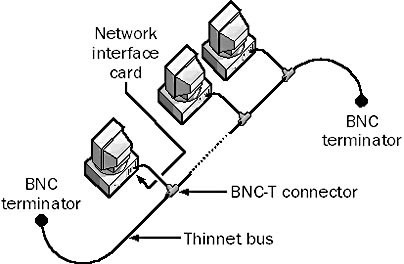
The bus topology was one of the earliest network designs used in Ethernet environments.
Although considered legacy today, it remains essential for understanding how networks behave — including Wi-Fi, which inherited many of the same limitations and concepts.
Just as a medical student cannot ignore anatomy, a network professional cannot skip the fundamentals. Several behaviors at the physical and data-link layers only make sense when you understand how early Ethernet networks worked.
Why Study the Bus Topology Today?
Understanding this topology helps you recognize:
- how collision domains originated,
- why switches became revolutionary,
- how CSMA/CD worked,
- why early Ethernet had poor scalability,
- and how these concepts reappear in modern Wi-Fi.
What Is the Bus Topology?
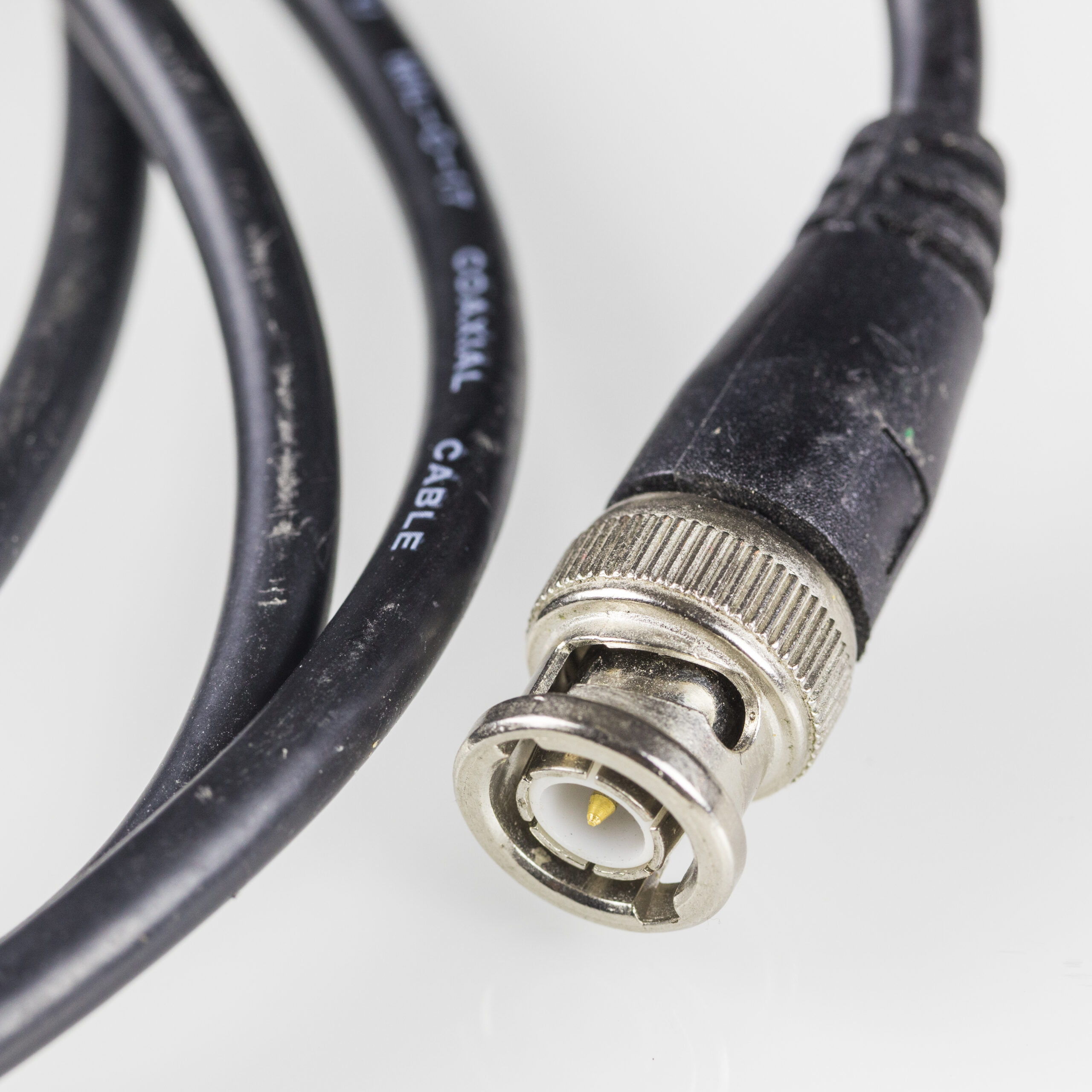
In a bus topology:
- All computers are connected to the same continuous cable, forming a shared medium.
- This cable was typically coaxial (10BASE2 or 10BASE5).
- Every device shared the same physical channel for transmitting and receiving data.
It works similarly to cable TV distribution: one cable carrying the signal to multiple devices.
Problem 1 — A Shared Medium
Whenever a device transmitted data, every other device on the cable received it, even if they were not the intended recipient.
This resulted in:
- mandatory broadcast behavior,
- unnecessary traffic,
- increased latency,
- reduced network efficiency.
There was no segmentation or intelligent traffic separation.
Problem 2 — Constant Collisions
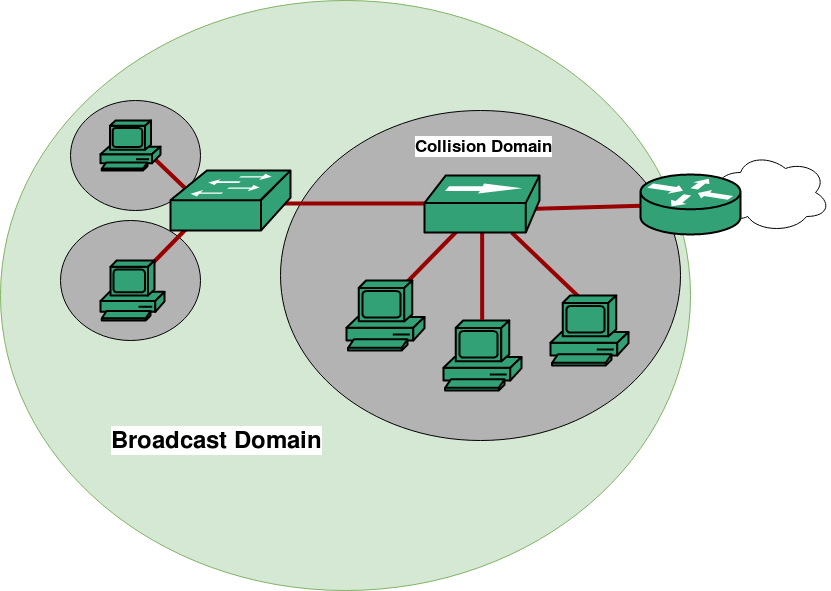
Because all hosts shared the same cable, if two devices transmitted simultaneously, their electrical signals collided.
Consequences included:
- corrupted frames,
- retransmissions,
- network slowdown,
- exponential collision growth as more hosts were added.
Bus Networks Operated in Half-Duplex
Another important characteristic: early Ethernet in bus topology was half-duplex only.
This means:
- a device could not listen and transmit at the same time,
- during transmission, the host became “blind” to the medium,
- if another device transmitted simultaneously, a collision occurred, detected only after the frame was damaged.
This half-duplex behavior significantly increased collisions and limited throughput.
Modern Wi-Fi still operates under half-duplex constraints, inheriting this same limitation.
Problem 3 — Extremely Limited Scalability
Adding more hosts to the bus increased:
- the likelihood of collisions,
- congestion on the medium,
- latency,
- broadcast volume,
- and the risk of network-wide failures.
Additionally, a single cable break could take down the entire network.
CSMA/CD — Ethernet’s Attempt to Control the Medium

To manage transmission on the shared medium, Ethernet used CSMA/CD (Carrier Sense Multiple Access with Collision Detection).
It worked as follows:
- The device listened to the medium to check if it was idle.
- If free, it began transmitting.
- If another device transmitted at the same time → collision.
- Both devices detected the collision.
- Each waited for a random backoff time before retrying.
Critical limitation:
👉 CSMA/CD only detects collisions after they happen.
It does not prevent them — it reacts to them.
This made large bus-based networks highly inefficient.
The Single Cable: A Physical and Logical Bottleneck
Beyond collisions, the bus topology suffered from:
- no segmentation,
- no traffic isolation,
- low speeds,
- no built-in security,
- difficult troubleshooting and maintenance,
- a single point of failure.
The natural evolution was the introduction of hubs and later switches, which finally eliminated shared collision domains.
How Bus Concepts Resurface in Wi-Fi
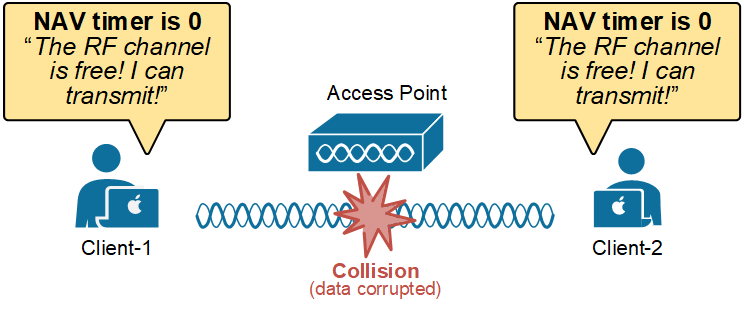
Although coaxial bus networks disappeared, the concept of a shared medium returned in wireless networks.
In Wi-Fi:
- all devices share the same channel,
- the medium is half-duplex,
- collisions still occur — but cannot be detected directly,
- devices rely on CSMA/CA (Collision Avoidance) instead of CSMA/CD.
In other words. The bus topology died in wired Ethernet, but lives on in wireless networking.
Deixe um comentário